
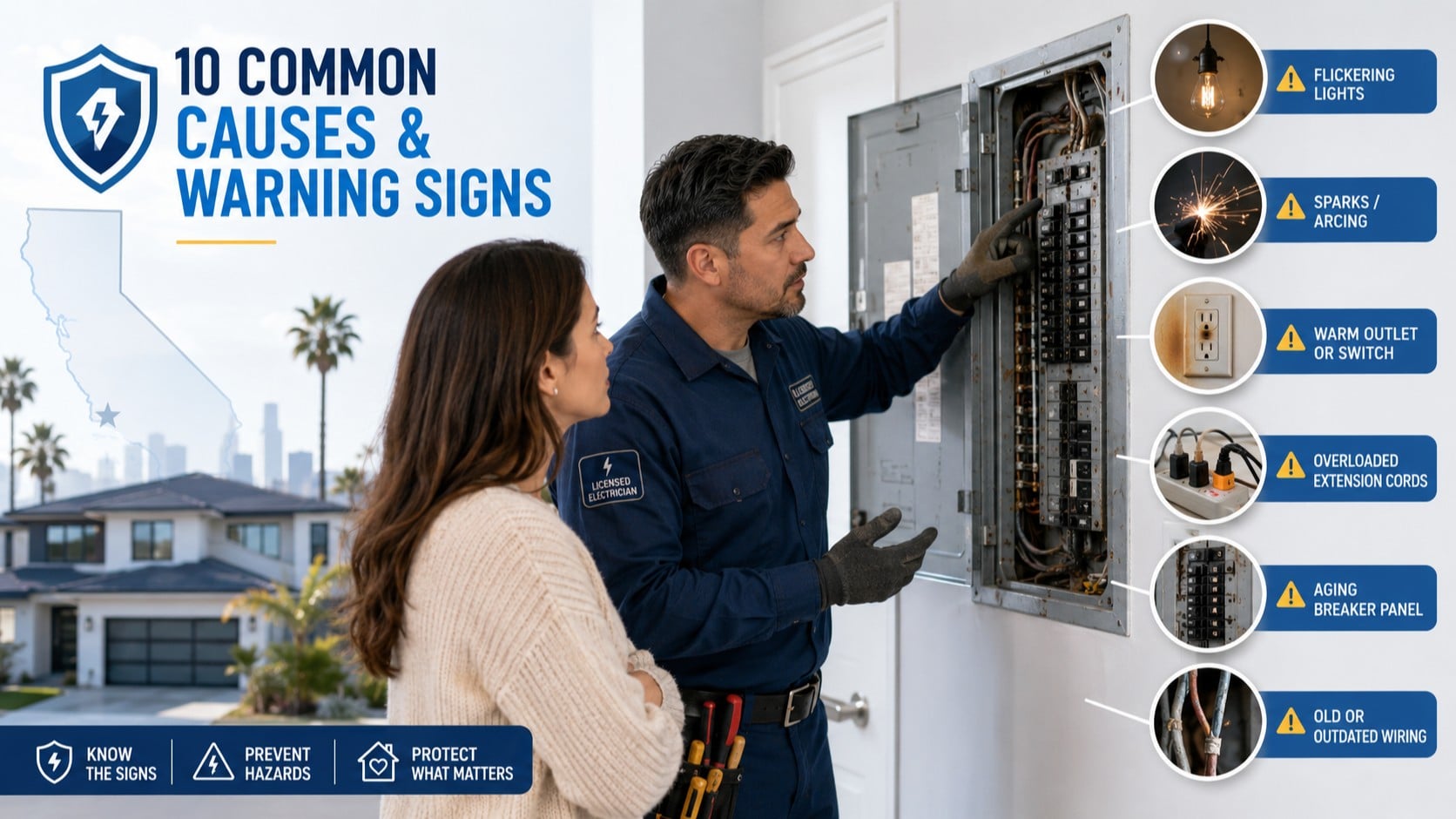
Key Takeaways
- Overloaded circuits are the single most common reason a breaker trips and the easiest to fix without calling an electrician.
- A circuit breaker that trips repeatedly is never just an annoyance; it is a safety signal that something in your electrical system needs attention.
- Warning signs like burning smells, hot outlet covers, or buzzing sounds can appear well before a fire starts.
- AFCI and GFCI devices are two of the most effective upgrades an older home can get, and modern building codes now require them in many areas.
- Extension cords cause roughly 3,300 residential fires every year, a statistic most homeowners have never heard.
Your Breaker Keeps Tripping and Here Is Why It Matters
A tripping circuit breaker is easy to brush off. Flip it back on, move on with the day. A breaker that trips once in a while is doing exactly what it was designed to do: cut power before something dangerous happens. But a breaker that trips frequently is a different story entirely.
The National Fire Protection Association (NFPA) estimates an annual average of 46,652 home electrical structure fires between 2020 and 2024, resulting in an estimated 527 civilian deaths, 1,580 civilian injuries, and $2.4 billion in direct property damage each year. Many of those fires do not start with a dramatic event. They begin with warning signs that get ignored, and a repeated breaker trip is one of the loudest of those warnings.
Understanding why a breaker keeps tripping puts homeowners in a much stronger position to respond appropriately, whether that means redistributing appliances, replacing a faulty device, or calling a licensed electrician. Electrical safety experts point to the same truth: most electrical hazards are preventable when homeowners know what to look for. FunnelTide’s guide covers the 10 most common causes and the warning signs that should never be ignored.
Top 10 Causes of Frequent Circuit Breaker Trips
1. Overloaded Circuits: The Number One Culprit
An overloaded circuit is by far the most common reason a breaker trips. It happens when too many devices draw power from the same circuit at the same time, pushing the total wattage beyond what that circuit can safely handle.
A standard 15-ampere branch circuit can safely carry up to 1,500 watts, while a 20-ampere circuit handles up to 2,000 watts. Plugging a 1,400-watt space heater and a 1,000-watt microwave into the same circuit puts the load at 2,400 watts, well over either limit.
The fix is often straightforward: spread high-draw appliances across different circuits. If a kitchen, laundry room, or home office keeps tripping despite that effort, the circuit itself may need to be evaluated by a licensed electrician.
- Common overload culprits: space heaters, hair dryers, microwave ovens, air fryers, vacuum cleaners
- Quick check: Add up the wattage of everything plugged into one circuit at peak use. If it exceeds 1,500W on a 15A circuit or 2,000W on a 20A circuit, that is your answer.
2. Short Circuits: Sudden Surges and Fire Risk
A short circuit is more serious than an overload. It occurs when a hot wire makes direct contact with a neutral wire or a ground wire, creating a sudden, massive surge of electrical current. The breaker trips instantly, but the hazard does not disappear with a reset.
Short circuits generate intense heat in a fraction of a second. If the breaker does not respond fast enough, or if the wrong breaker is installed, that heat can ignite nearby insulation or structural materials. Common causes include damaged wire insulation, loose terminal connections inside outlets, and faulty internal wiring in appliances.
Never reset a breaker repeatedly after a short circuit without identifying the cause first. If the breaker trips again immediately after resetting, stop and call an electrician.
3. Ground Faults from Damaged Insulation or Moisture
A ground fault is similar to a short circuit, but instead of a wire-to-wire contact, electricity takes an unintended path directly to the ground, often through a person, a wet surface, or damaged insulation. Bathrooms, kitchens, garages, and outdoor outlets are especially vulnerable because of their exposure to water.
GFCI outlets are specifically designed to detect ground faults and cut power in milliseconds, fast enough to prevent serious injury. When a GFCI outlet trips, it is doing its job. But if it trips repeatedly, there is an underlying problem: damaged wiring, moisture intrusion, or a faulty appliance connected to that circuit.
Ground faults should not be reset without investigating the cause, particularly in wet areas of the home.
4. Arc Faults from Frayed Wires or Loose Connections
Arc faults are one of the most dangerous and least visible electrical hazards in a home. They occur when electricity jumps across a gap caused by damaged, frayed, or loosely connected wiring. The resulting spark can ignite surrounding materials without triggering a standard circuit breaker, because the current draw may not exceed the breaker’s rated limit.
The Electrical Safety Foundation International (ESFI) reports that arcing faults are responsible for starting more than 28,000 home fires each year, killing and injuring hundreds of people, and causing over $700 million in property damage. Arc Fault Circuit Interrupter (AFCI) breakers are designed specifically to detect these conditions and shut the circuit down before ignition occurs.
Older homes with aging wiring are especially at risk. Standard breakers do not catch arc faults. Only AFCIs do.
5. Faulty Appliances with Internal Faults or Damaged Cords
Sometimes the problem is not the wiring in the walls but the appliance plugged into the outlet. An appliance with a damaged cord, a failing internal component, or an internal short circuit can draw erratic or excessive current, causing the breaker to trip every time it is used.
The diagnostic is straightforward: if the breaker trips only when one specific appliance is running, that appliance is the likely culprit. Unplug it and test the circuit with something else. If the breaker holds, the appliance needs to be repaired or replaced, not the wiring.
Pay particular attention to cords that feel warm during use, show visible fraying, or have been repaired with tape. The CPSC explicitly warns against using appliances with damaged cord insulation.
6. Aging or Failing Circuit Breakers
Circuit breakers are not designed to last forever. Over time, the mechanical and electrical components inside a breaker can wear out, causing it to trip at loads it should handle easily, or worse, fail to trip when it genuinely should.
Homes with older electrical panels, particularly those 40 or more years old, are often overdue for evaluation by a licensed electrician. A breaker that feels loose, will not reset firmly, or trips without any apparent overload may be failing internally. This is not a DIY fix. Breaker replacement involves working inside a live electrical panel and must be handled by a licensed electrician.
A failing breaker that does not trip when it should is arguably more dangerous than one that trips too often, because it removes the last line of defense against overheating and fire.
7. Outdated or Damaged Home Wiring
Wiring does not get better with age. Insulation becomes brittle, connections loosen, and older wiring materials, particularly aluminum wiring common in homes built between the mid-1960s and mid-1970s, can develop resistance and overheat at connection points. DIY wiring jobs done without proper knowledge of electrical code add another layer of risk.
Frayed wires, cracked insulation, and loose connections inside outlet boxes can all cause repeated breaker trips, overheating, and increased fire risk. The CPSC specifically flags aluminum wiring connections to outlets and switches as a hazard, noting that these connections tend to loosen over time and lose good electrical contact.
If a home was built before 1970 and has not had a wiring inspection, scheduling one with a licensed electrician is a worthwhile investment in safety.
8. Overuse of Extension Cords
Extension cords are meant to be temporary solutions, not permanent fixtures. When used as a substitute for permanent wiring, the risks compound quickly. A cord that is too light for the load placed on it will overheat. A cord run under a rug, through a doorway, or pinched behind furniture can develop damage that is invisible until it becomes a serious problem.
The LA County Fire Department has identified overused extension cords as the leading cause of home electrical fires in their service area. The long-term answer is not a heavier-duty extension cord. It is having a qualified electrician install additional outlets where they are needed.
The CPSC is explicit on this point: extension cords are intended for short-term use only, and using them as permanent wiring substitutes is a recognized fire hazard.
9. Undersized or Outdated Electrical Panels
Older homes, particularly those built before 1970, were designed around the electrical demands of that era. A 60-ampere service panel, which was once standard, was simply not built to handle today’s combination of HVAC systems, electric ranges, EV chargers, home offices, and entertainment systems running simultaneously.
When a panel is undersized for the load placed on it, breakers trip more frequently. Some older panels may contain breakers rated higher than the wiring they protect, a dangerous condition that removes the intended safety protection.
If a home has a 60-ampere or 100-ampere panel and experiences frequent trips across multiple circuits, a panel upgrade to 150 or 200 amperes is worth discussing with a licensed electrician.
10. Older Home Electrical Systems Under Modern Demand
This cause ties together several of the ones above, but it deserves its own mention because the scale of the issue is significant. Roughly half of today’s homes were built before 1970, designed around electrical loads that look nothing like what is plugged in today.
Hairdryers, computers, gaming systems, smart home devices, and large kitchen appliances all place demands on wiring systems that were never designed to carry them. The Electrical Safety Foundation International (ESFI) estimates that home electrical problems lead to approximately 51,000 fires each year, nearly 500 deaths, more than 1,400 injuries, and $1.3 billion in property damage annually, with many of those incidents originating in older homes unequipped to handle modern demand.
Frequent tripping in an older home is often the electrical system communicating its limits. Listening to that signal and acting on it is far less costly than the alternative.
Warning Signs Your Electrical System Is in Trouble
Frequent breaker trips are one red flag, but they are rarely the only one. An electrical system under stress tends to show multiple symptoms. Knowing what to look and listen for can help catch a problem before it becomes a fire.
Flickering or Dimming Lights
Lights that flicker or dim when a large appliance kicks on, like a refrigerator compressor, air conditioner, or washing machine, indicate that the circuit is struggling to manage the electrical load. This can also signal loose connections somewhere in the wiring path.
Occasional, minor dimming is not always an emergency, but persistent flickering across multiple rooms, or dimming that has gotten progressively worse, is worth a professional evaluation. The CPSC lists dim or flickering lights as a recognized warning sign of electrical system problems.
Burning Smells or Scorch Marks on Outlets
A persistent burning smell, often described as hot plastic, a fishy odor, or the sharp smell of ozone, is one of the most serious warning signs on this list. It indicates that wiring or insulation is actively overheating somewhere in the system.
Visible scorch marks or discoloration around outlet covers or at the electrical panel are the visual equivalent of that smell. Both signal an imminent fire hazard. Do not ignore either of these signs. Turn off the affected circuit at the panel and contact a licensed electrician immediately.
Buzzing, Sizzling, or Humming Sounds
Electricity, when properly contained, is silent. Buzzing, sizzling, crackling, or humming sounds coming from outlets, switches, light fixtures, or the electrical panel are auditory indicators of loose or vibrating wires, failing connections, or active arcing.
The CPSC specifically identifies sizzles and buzzes as a warning sign category for the electrical panel and notes that unusual sounds from the electrical system warrant immediate attention. These sounds do not always precede a visible event. Sometimes the damage happens inside a wall, out of sight, until it is too late.
Hot Switch Plates or Outlet Covers
Switch plates and outlet covers can feel slightly warm under normal conditions, particularly if current is passing through connections behind them. But a faceplate that is hot, uncomfortable or painful to touch, is not normal. The CPSC is direct about this: parts of the electrical system may be warm but should never be hot.
A hot outlet cover indicates overheating in the receptacle, switch, or wiring behind it, which is a potential fire hazard. Stop using that outlet or switch immediately and have a qualified electrician assess it as soon as possible.
Visible Arcs or Sparks
Seeing a brief flash when plugging something in is not always dangerous. A small spark can occur when a plug makes contact with a live outlet. But bright flashes, showers of sparks, or arcing that happens when simply turning a switch on or off is a serious warning sign.
The CPSC lists arcs and sparks as a hazard indicator for electrical service equipment, outlet receptacles, and switches throughout the home. Any visible arc or persistent sparking should be evaluated immediately. Do not attempt to identify or repair the source yourself.
How AFCIs and GFCIs Protect Your Home
Two types of safety devices stand between common electrical hazards and serious harm: AFCI breakers and GFCI outlets. They are often confused because they sound similar, but they protect against very different risks, and both are important.
AFCI Breakers: Defense Against Electrical Fires
Arc Fault Circuit Interrupters, or AFCIs, are designed to detect the kind of dangerous electrical arcing that standard breakers miss entirely. A typical household circuit breaker responds to overcurrent, meaning too many amps flowing through the wire. But arc faults can generate intense heat and ignite fires even when the current draw is within the breaker’s rated limit.
AFCI breakers monitor for the signature electrical pattern of an arc fault and cut power before ignition can occur. The CPSC has found AFCI technology to be effective and recommends it especially for older homes with aging wiring systems, where arc faults are more likely to develop. Modern building codes now require AFCI protection in most residential living spaces for new construction and many renovations.
Installation must be performed by a licensed electrician. Working inside an electrical panel box carries serious shock risk, even with the main breaker off.
GFCI Outlets: Protection from Electrical Shock
Ground Fault Circuit Interrupters, or GFCIs, serve a different purpose: protecting people from electrical shock, particularly in areas where water and electricity can come into contact. Bathrooms, kitchens, garages, basements, and outdoor outlets are all required to have GFCI protection under current electrical codes.
A GFCI outlet detects tiny imbalances in electrical current and cuts power within milliseconds. The Electrical Safety Foundation International (ESFI) estimates that if GFCIs were present in most older homes, approximately 47% of current electrocutions could be prevented.
GFCI outlets have a TEST and RESET button on their face. The CPSC recommends testing them monthly to confirm they are functioning correctly.
Extension Cord Dangers Most Homeowners Ignore
Extension cords are one of the most universally underestimated fire hazards in the average home. They are inexpensive, convenient, and seemingly harmless, which is exactly why they are misused so often and so seriously.
CPSC Data: Around 3,300 Fires and 50 Deaths Annually
The U.S. Consumer Product Safety Commission estimates that extension cords are responsible for approximately 3,300 residential fires and 50 deaths every year. Those numbers reflect the real-world consequences of treating a temporary solution as a permanent one.
LA County Fire Department inspector Rick Flores put it plainly: overusing extension cords is the number one fire threat. His recommended solution is not a heavier cord. It is having a professional electrician install additional permanent outlets where they are needed.
Common Misuses That Lead to Overheating
Extension cord fires do not usually start with a single dramatic mistake. They build from habits that seem harmless individually but create significant risk over time.
- Running cords under rugs or carpets traps heat and hides damage
- Pinching cords in doorways or behind furniture damages insulation over time
- Daisy-chaining extension cords or power strips multiplies the load far beyond any single cord’s rating
- Using lightweight No. 18 gauge cords for high-draw appliances causes the cord to overheat at loads it was not designed to carry
- Using extension cords as permanent wiring substitutes is explicitly identified by the CPSC as a fire hazard
- Using damaged cords, including those that have been patched or repaired, poses a fire hazard, as the CPSC warns against using any cord with compromised insulation or makeshift repairs
The rule of thumb: if an extension cord has been in the same spot for more than a few weeks, it is already serving a purpose that a permanent outlet should be handling.
Frequent Trips Are a Warning: Call a Licensed Electrician Before It Becomes a Fire
A circuit breaker protects a home’s wiring from carrying more current than it can safely handle. When it trips repeatedly, the system is signaling a problem—whether that is an overloaded circuit, failing appliance, aging wiring, undersized panel, or developing arc fault.
The right response is to find and correct the cause, not keep resetting the breaker or replace it with a higher-rated one. A higher-rated breaker does not fix an overloaded circuit; it removes the protection the original breaker was providing.
Some issues, like redistributing appliances or replacing a faulty device, may be simple. But anything involving the panel, in-wall wiring, breaker replacement, burning smells, hot outlets, or repeated trips should be handled by a licensed electrician.
Electrical contractors, use educational content to help turn homeowner safety concerns into informed service calls. FunnelTide Marketing helps electrical businesses create and distribute authority-building content, improve visibility, build trust, and helps local customers find the right professional before small warning signs become major problems.
FunnelTide Marketing
lesliecambra@funneltide.com
12060 Industry Boulevard
#1051
Jackson
California
95642
United States


